
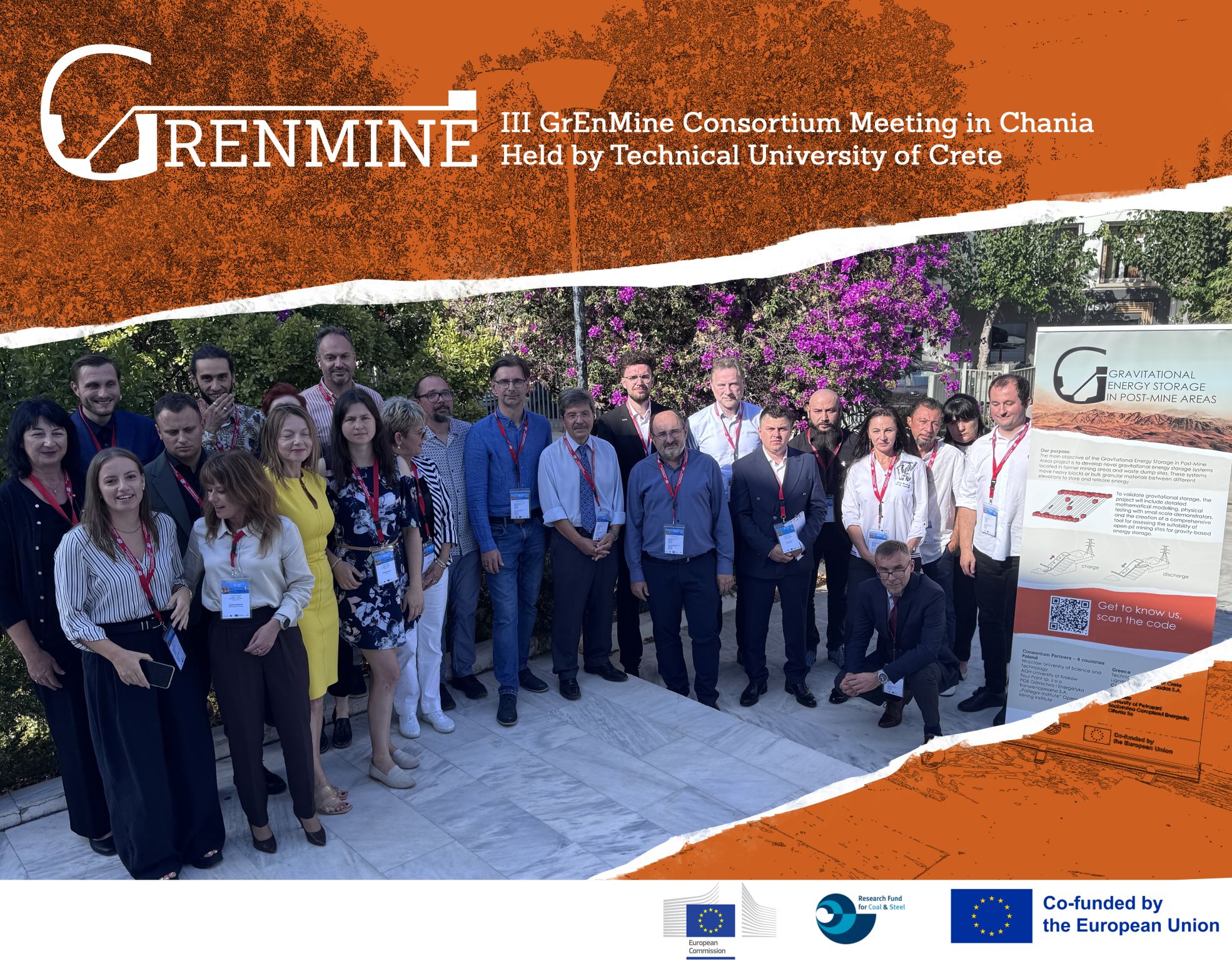
While autumn was settling across much of Europe, the GrEnMine consortium gathered in Crete for its 3rd project meeting — two days dedicated to advancing the development of gravitational energy storage in post-mine areas.
The event was hosted by the Technical University of Crete (TUC), whose team provided both the venue and an inspiring academic environment for discussions at the intersection of mining engineering and energy innovation.
The meeting brought together representatives of the international partnership coordinated by Wrocław University of Science and Technology (WUST), the project’s consortium leader. Partners from AGH University of Krakow, Complexul Energetic Oltenia, Universitatea din Petroșani, Poltegor-Instytut, VUHU a.s., and other European institutions aligned their ongoing research, engineering progress, and strategic next steps.
The event was opened by Professor Emmanuel Steiakakis, Dean of the School of Mineral Resources Engineering, who welcomed participants and highlighted the strategic importance of innovation in energy storage for mining regions in transition.
During the technical sessions:
- Professor Michael Galetakis and his team presented recent developments in conveyor-belt gravitational energy storage systems,
- Professor Przemysław Moczko (WUST), representing the consortium leader, shared key engineering milestones related to the construction of the demonstrator, detailing advances in structural engineering, system validation, and implementation planning, and provided a strategic overview of the initiative’s progress toward full-scale deployment.
- Professor Marek Cała (AGH University of Krakow) introduced the latest geotechnical findings and presented the foundation of the terrain assessment tool supporting safe system deployment,
- Michał Twardosz, Head of Communication, led the session on communication and dissemination strategy, focusing on translating scientific progress into structured dialogue with stakeholders.
The meeting marked an important step in synchronising scientific research, engineering design, and implementation planning. As renewable energy continues to expand across Europe, gravitational energy storage offers a complementary solution to grid instability — storing energy not in chemical cells, but in elevation.
GrEnMine continues to move from concept to demonstrator — and from data to deployment.