
In June 2025, solar power became the largest source of electricity in the European Union for the first time. The sun accounted for 17% of the energy mix—more than any other source [Reuters, 9 July 2025].
It is a historic milestone. But also a warning signal: the higher the share of renewables in the grid, the greater the instability. We need not only generation, but stabilisation.
This is where gravitational energy storage (GES) enters the picture. This is where AGH University of Krakow plays a key role in the GrEnMine project, identifying where and how such systems can be safely deployed.
GES: Energy Storage Without Batteries
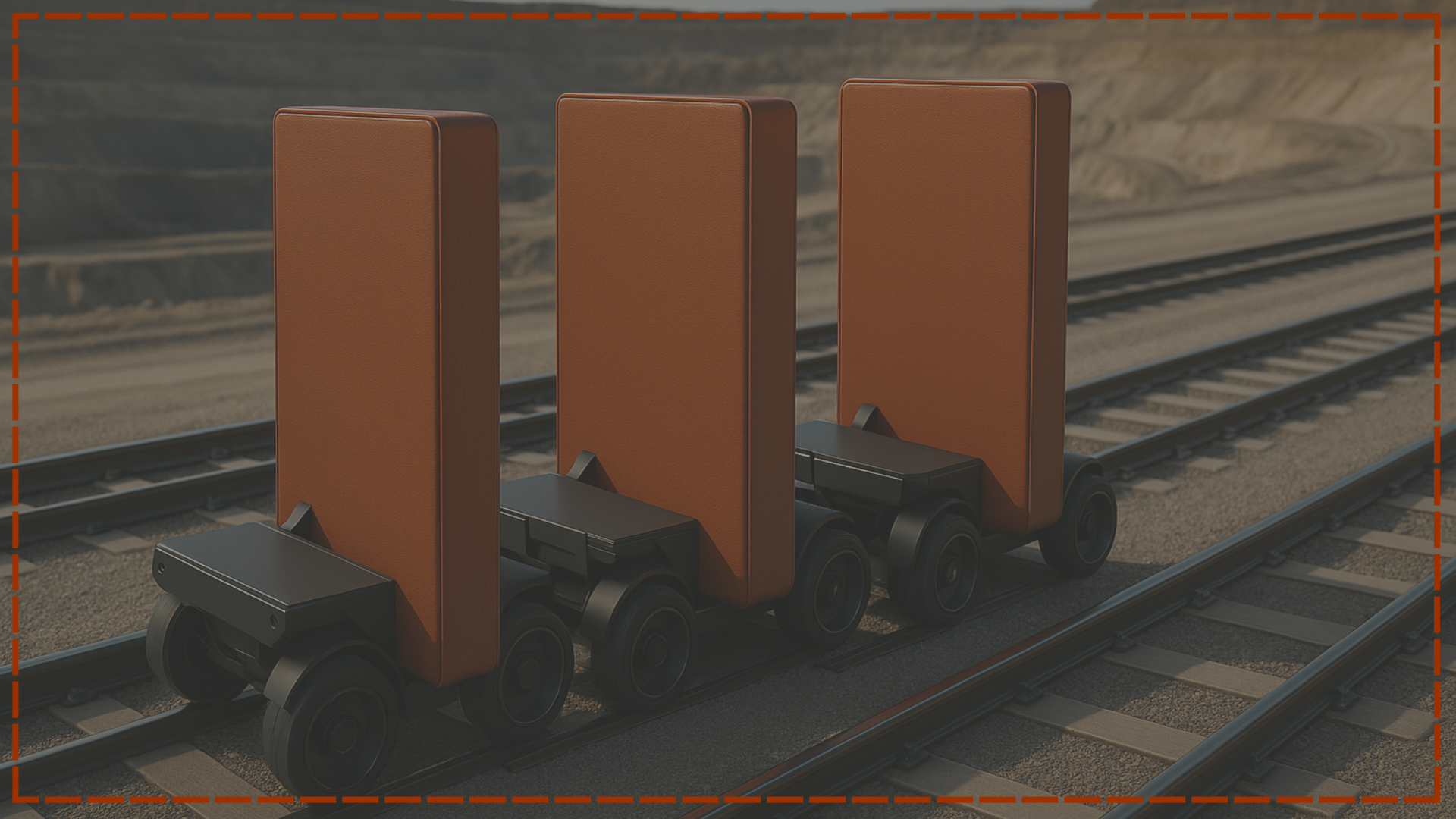
Unlike lithium-ion batteries, GES systems do not store energy chemically. They rely on gravity. When excess electricity is available, heavy masses are moved upward. When energy is needed, the mass descends, converting potential energy back into electricity.
The principle is simple. The implementation is not.
Especially when such systems are to be constructed in post-mining areas, precise geotechnical and spatial analyses become essential. This is where AGH contributes its unique expertise.
A team of AGH specialists is developing geotechnical models for selected locations, analysing slope stability and soil structures, and identifying risks related to both static and dynamic loads.
What does this provide?
Confidence that investments in GES will not fail at the construction stage.
AGH’s data does not merely determine whether something can be built—it shows exactly where and how it can be done safely.
Demonstrator and… Something More: A Digital Tool for Planning the Future
GrEnMine, funded under the Research Fund for Coal and Steel programme, is coordinated by Wrocław University of Science and Technology (WUST), which leads the international consortium and oversees the project’s strategic and technological direction.
The initiative goes beyond building a single demonstrator of a gravity-based storage system.
Alongside the physical demonstrator, a digital tool is being developed to assess the future potential of other post-mining areas—not only in Poland, but across the European Union.
AGH also contributes to this system. The platform integrates geospatial, geotechnical, and infrastructural data to answer a fundamental question:
Where does it make sense to build gravitational energy storage systems—and in what configuration?
Instead of experimenting directly in the field, investors, grid operators, and decision-makers will receive a digital analytical tool based on real data and simulations. It is, in essence, a roadmap for distributed, low-emission energy storage systems.
AGH: Research That Enables Decisions
Within the GrEnMine project, AGH plays a key role in:
- geotechnical modelling and soil stability assessment,
- social analysis (coexistence of GES systems with other land-use functions),
- building a database of potential stakeholders and solution end-users.
“Technology is one thing, but an equally important question is: can this land carry the weight of the future?”
says Prof. Marek Cała from AGH.
“Our task is to verify that—before anyone installs the first pole or rail.”
The GrEnMine project runs until June 2027 and brings together 10 partners from Poland, the Czech Republic, Greece, and Romania.
For AGH, participation in GrEnMine is not only involvement in a breakthrough technological initiative—it is a tangible response to the challenges of the energy transition.
Because if solar and wind energy are to truly power our system, they must have a place to pause before reaching the socket.